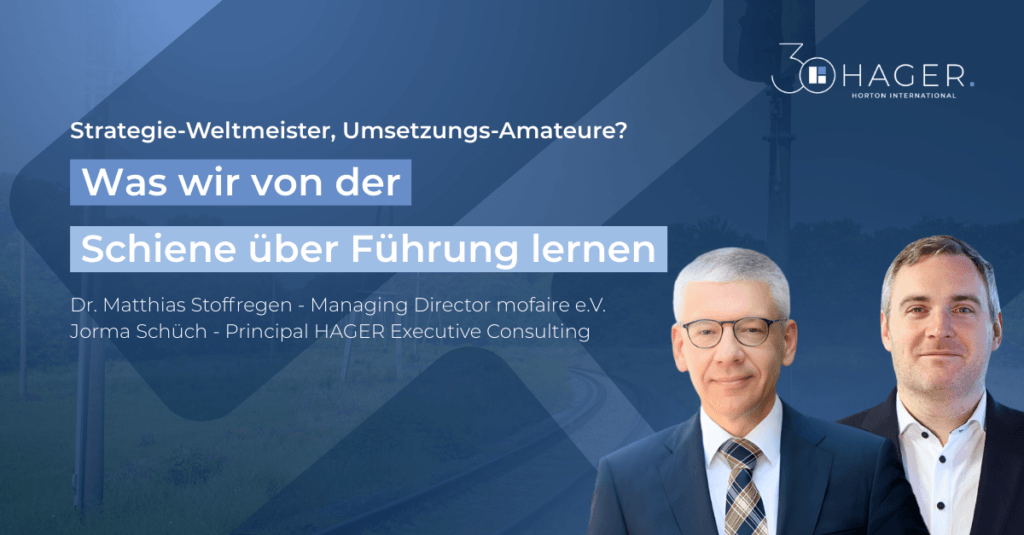
Investment funds are flowing, concepts are in place and political goals have been set. Nevertheless, there are problems at every turn. Why Germany’s rail transport system has an implementation problem rather than a knowledge problem is a question that goes far beyond tracks and trains. The state of the railways today is a prime example of what really causes large organisations to fail in their transformation.
Translated with DeepL.com (free version)
Dr Matthias Stoffregen, managing director of the industry association mofair e. V., and Jorma Schüch from HAGER Executive Consulting analysed this imbalance in a dialogue. Their joint observation: in Germany, we have no problem defining goals – we simply lack the power to get the horsepower onto the road, or rather the rail.
Das Paradoxon der Sichtbarkeit
‘We actually know exactly what needs to be done,’ explains Stoffregen in an interview. ‘The only question is why it’s not happening.’ He therefore calls for a radical shift in priorities. Instead of concentrating solely on prestigious new construction projects such as those in the Lüneburg Heath, the focus should be much more on stabilising existing infrastructure. Additional sidings, overtaking options or the elimination of minor bottlenecks may not win any press conferences, but they strengthen the capacity of the overall system immediately and cost-effectively.
Jorma Schüch sees a parallel here with many other industries. Decision-makers often underestimate the impact of these small, operational levers and instead chase after symbolic large-scale projects. But for a strategy to be successful, it is the impact in the engine room that counts, not the glamour on the stage.
Reliability as the hardest currency in the transport revolution
Rail remains the backbone of any climate strategy, and products such as the Deutschlandticket show that people are willing to switch. But this structural advantage is wasted if the experience on the platform is not right. Stoffregen sums it up: the transport revolution is not failing because of the concepts, but because of the lack of reliability in operation. His goal for the next ten years is therefore less technical and more cultural in nature. He wants rail travel to stop being the number one frustrating topic of small talk at every party. Ultimately, transformation will only succeed if the strategic promise is reliably delivered in the everyday lives of customers.
Competition as a necessary wake-up call
Competition is an important factor in ensuring this reliability. While local transport already works well, Deutsche Bahn still has a virtual monopoly on long-distance transport. But that is currently changing. International providers such as Italy’s Italo and Czech companies such as Leo Express and RegioJet are pushing their way onto the German market. Stoffregen sees this as a positive development: “We will be happy to welcome any new provider that delivers quality when the market leader is faltering. For companies, this means that competitive pressure is often the best driver of operational excellence.
When the signal box remains empty: humans as the bottleneck
The most critical bottleneck in the system today is no longer capital, but personnel. The shortage of skilled workers affects the entire value chain – from train drivers to highly specialised infrastructure acceptance inspectors.
An example from the Rhineland illustrates the dramatic nature of the situation: on Rose Monday, the signal box in Dormagen was in danger of remaining unmanned. Only at the last moment was a solution found to enable the revellers to get to the Cologne parades at all. Without these people, the entire system would collapse. Important digital innovations such as the new ETCS safety system on the Riedbahn line are also currently delayed by years because there are simply not enough experts for planning and final approval.
Herein lies the universal lesson for CEOs and board members: capital can be mobilised, but minds that can truly manage, review and take responsibility for complex projects are the real scarce commodity. Those who fail to secure the operational complexity with the right personnel will find that their strategy remains nothing more than a paper tiger.
Implementation power as a new competitive advantage
The future of rail will not be decided by subsidy programmes, but by the quality of implementation. Above all, this requires a new approach to selecting managers. The search is no longer on for flawless administrative CVs, but for personalities who can lead transformation in uncertain times and are prepared to tolerate contradictions.
True leadership is demonstrated by mastering the small details that keep a system stable. Those who understand that personnel risks are the greatest strategic risks today will secure a real competitive advantage. Strategy is necessary, but it is far from sufficient. The organisations that will win are those that not only know where they want to go, but also actually get there.