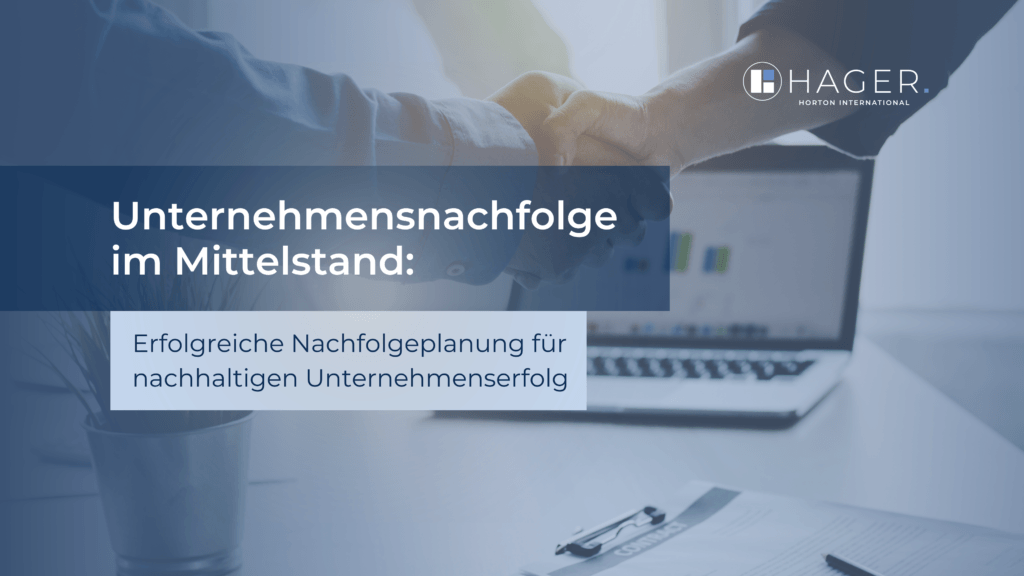
Business succession in small and medium-sized enterprises: Successful succession begins with the right leadership
Business succession is one of the most important strategic decisions a company faces. Choosing the right leaders plays a decisive role in determining whether a handover brings stability or increases risks.
In Germany, small and medium-sized enterprises are facing a historic challenge. In the coming years, tens of thousands of companies will have to find a succession plan. At the same time, digitalisation, artificial intelligence, geopolitical uncertainties and the shortage of skilled workers are fundamentally changing the demands placed on managers.
In small and medium-sized enterprises in particular, leadership is closely linked to corporate culture, values and long-term customer relationships. Successful succession planning within a company therefore takes into account not only qualifications and experience, but also cultural fit, the ability to drive change, and the capacity to inspire employees during times of change.
With over 30 years’ experience in executive search, HAGER supports medium-sized companies, family-owned businesses and private equity investors in filling demanding leadership roles. Our experience from national and international search mandates shows that successful management succession does not begin with the search for candidates, but with a clear definition of the future requirements for the company’s leadership.
What does business succession mean?
The term ‘business succession’ refers to the planned handover of business responsibility from one person or a group of shareholders to a new management team. This is not solely a matter of ownership. The appointment of management and leadership roles is equally crucial, as it has a decisive influence on the future development of the business.
Succession processes vary considerably depending on a company’s structure and objectives.
Business succession is more than just a transfer of ownership
Today, business succession is about much more than simply transferring ownership or filling a management position. A successful succession does not end with the signing of a contract. Only when new managers build trust, get staff on board and drive the company’s strategic development can the generational or ownership transition be considered a lasting success.
At the same time, the operating environment has changed fundamentally. Digitalisation, global markets, new regulatory requirements and artificial intelligence are increasing the complexity of business decisions. Added to this are skills shortages and demographic change, which are intensifying competition for qualified managers.
That is why many experts today no longer speak exclusively of business succession, but of management succession. The focus is not only on the question of who will take over responsibility, but above all on the skills that this person must possess in order to successfully guide the company through processes of change. In small and medium-sized enterprises in particular, there is now a demand for leaders who possess strategic foresight, technological expertise and the ability to bring together different stakeholders.
The biggest challenges in management succession
Why do business successions fail despite careful planning? The causes rarely lie in a single mistake. In most cases, several factors come together to complicate the transition or jeopardise long-term success.
HAGER encounters the following challenges particularly frequently in practice.
1. Succession planning starts too late
One of the most common reasons why generational succession proves difficult is a lack of time. Many business owners only start thinking about succession when their planned retirement is just around the corner or when an unexpected event requires swift action.
However, professional succession planning within a company should begin several years before the actual handover. This allows sufficient time to define requirements, assess internal potential and carefully select external candidates.
2. The requirements for future leadership are unclear
Many companies are looking for a manager who will replace the previous managing director as closely as possible. This approach often falls short.
It is not the past that should determine the job profile, but the strategic objectives for the coming years. Is the company set to expand internationally? Drive forward digitalisation? Integrate acquisitions? Tap into new markets?
Only once these questions have been answered will it be possible to define exactly what skills the future management team will actually need.
3. Professional expertise is overrated
An impressive CV alone is no guarantee of successful business leadership.
It is particularly during periods of transformation that skills such as change management, strong communication skills, strategic thinking and entrepreneurial initiative often prove decisive for the success of a succession.
That is why structured processes such as leadership assessment and management assessment are becoming increasingly important. They enable a more objective evaluation of leadership skills and reduce the risk of making the wrong appointment.
4. Cultural fit is underestimated
Even highly qualified managers can fail if their values, understanding of leadership and the corporate culture are not aligned.
In small and medium-sized enterprises in particular, trust, long-term relationships and a sense of identification with the company play a key role. Cultural fit is therefore not a ‘soft factor’, but an essential component of successful management appointments.
5. Digitalisation and AI are not taken into account
The demands placed on managing directors are changing rapidly. Digital business models, data-driven decision-making and the use of artificial intelligence are having an impact on virtually every sector.
Companies should therefore start assessing now what technological and strategic skills their future management will need. This topic will be examined in greater detail later in the article.
An overview of the biggest challenges
| Challenge | Implications for business succession |
| Demographic change | Many business owners are reaching retirement age at the same time. There is a limited supply of suitable successors. |
| Skills shortage | Competition for experienced managing directors and senior executives is increasing significantly. |
| Digitalisation | New business models and technologies require additional management skills. |
| Transformation | Companies must simultaneously drive change and manage their day-to-day operations in a stable manner. |
| Corporate culture | The cultural fit of new managers is often a key factor in long-term success. |
Owner-managed companies, in particular, often underestimate just how much the demands placed on managing directors have changed over the past ten years. Today, operational excellence alone is no longer enough. What is needed are individuals who can bring together strategy, transformation, technology and people in equal measure.
When should succession planning begin?
This question is one of the most common search queries relating to business succession, and the answer is clear:
Ideally, succession planning should begin three to five years before the planned handover.
This period offers plenty of opportunities:
- Reviewing the corporate strategy
- Defining future skills profiles
- Assessing internal talent objectively
- Getting to know external candidates
- Externe Bewerber kennenlernen
- Preparing for a structured handover
If a succession needs to take place at short notice, the risk increases significantly. Companies make decisions under time pressure, consider fewer candidates and often focus on solutions that are available in the short term rather than on the best long-term appointment.
The role of executive search in complex succession processes
The more complex the company’s situation, the more important a structured search process becomes.
For more than three decades, HAGER has been supporting companies, family-run businesses and private equity investors in filling demanding leadership roles.
It is not simply a matter of identifying suitable candidates. What is crucial is a systematic selection process that takes equal account of strategy, corporate culture and future requirements.
The service modules include, amongst other things:
- Executive Search for Managing Directors, Board Members and C-level positionsExecutive Search für Geschäftsführer, Vorstände und C-Level-Positionen
- Leadership Assessment for the objective evaluation of leadership skills
- Management assessment for internal and external candidates
- Board Services for the recruitment and development of advisory and supervisory boards
- Support for succession processes in family businesses
- Management appointments in the private equity and M&A sectors
This holistic approach reduces the risk of hiring the wrong people and lays the foundations for long-term business success.
The stages of a professional executive search process
A structured executive search process usually comprises the following steps:
| Phase | Objective |
| Analysis | Understanding corporate strategy, culture and vision |
| Skills Profile | Defining professional, strategic and personal requirements |
| Market analysis | Identify relevant target companies and candidates |
| Direct contact | Approach suitable candidates discreetly |
| Leadership Assessment | Assessing leadership skills in a structured way |
| Bewertung der Geschäftsführung | Comparison of internal and external candidates |
| Selection process | Interviews, references and decision-making support |
| Onboarding | Supporting integration into the organisation |
This systematic approach significantly reduces the risk of making the wrong appointments and provides a sound basis for decision-making for shareholders, advisory boards and investors.
The skills managing directors need today
The role of the managing director has changed fundamentally in recent years.
In the past, the focus was on operational management, industry knowledge and business experience. Today, managing directors must also shape digital transformation, evaluate new technologies, engage with various stakeholders and steer companies through an increasingly volatile environment.
The question is therefore no longer:
Who has the most experience?
Rather:
Who has the skills to lead the company successfully into the future?
An overview of the key leadership skills
| Expertise | Implications for business succession |
| Strategic thinking | Developing long-term business objectives |
| Transformation competence | Managing change successfully |
| Digital literacy | Using digitalisation as a competitive advantage |
| Understanding AI | Assessing the potential and risks of artificial intelligence |
| Communication skills | Winning over staff, customers and investors |
| Change management | Leading organisations through change |
| Entrepreneurial thinking | Recognising opportunities and taking responsibility |
| Decision-making ability | Making clear decisions even in the face of uncertainty |
| Resilience | Maintaining stability in times of crisis |
| Value-based leadership | Strengthening corporate culture and building trust |
These skills are becoming increasingly important, regardless of sector or company size.
Professional expertise remains important, but is no longer enough
Many successful managing directors possess impressive industry knowledge. Nevertheless, experience shows that professional excellence alone is no guarantee of successful business management.
Companies today are constantly undergoing change.
Managing directors are therefore increasingly required to facilitate, prioritise and provide guidance. It is precisely these skills that often determine whether transformation processes are successful.
AI is also changing the demands placed on managing directors
Artificial intelligence is one of the most significant technological developments of recent decades.
Many companies still view artificial intelligence solely as a technology project.
In fact, however, it is a strategic management issue.
Today, managing directors must be able to assess which processes can be automated, what opportunities generative AI offers, and what risks regulatory requirements entail.
You don’t need to be a data scientist yourself.
What is crucial is the ability to assess technological developments from a strategic perspective and to make the right decisions for the company.
What questions companies should be asking today regarding succession planning
When selecting future managing directors, it is therefore worth considering the following questions:
- Does the candidate understand the strategic implications of AI?
- Can he successfully lead digital transformation projects?
- Does he make data-driven decisions?
- Is he open to innovation and continuous learning?
- Can he get staff on board during change processes?
- Does he combine technical expertise with an entrepreneurial mindset?
These issues will become increasingly important in the coming years and should already form part of any professional succession planning today.
Checklist for a successful business succession
Successful business succession does not begin with the search for new management, but with clear strategic planning. The following checklist helps entrepreneurs, shareholders and advisory boards to take the key success factors into account at an early stage.
The 10 key steps to successful succession planning
| Step | Recommendation |
| 1. Start early | Ideally, you should start succession planning three to five years before the planned handover. |
| 2. Define the company’s objectives | Think about the direction in which you want your business to develop over the coming years. |
| 3. Create a skills profile | Define the professional, strategic and personal requirements for the future management team. |
| 4. Assessing internal potential | Assess objectively whether there are any suitable candidates within the company. |
| 5. Involve external managers | Widen your search radius to find the best possible candidate. |
| 6. Use the Leadership Assessment | Assess leadership skills in a structured and transparent manner. |
| 7. Take cultural fit into account | Make sure that values, leadership style and corporate culture are aligned. |
| 8. Assessing future-oriented skills | Digitalisation, AI expertise and the ability to adapt to change should form part of the selection process. |
| 9. Actively support the handover | Plan a structured induction programme and clearly defined responsibilities. |
| 10. Review progress regularly | Set targets for the first 100 days and review the onboarding process. |
Practical tip: Companies that plan their succession at an early stage and compare both internal and external candidates significantly increase their chances of making a successful appointment in the long term.
Frequently Asked Questions (FAQ) on Business Succession
When should succession planning begin?
Ideally, succession planning should begin three to five years before the planned handover. This allows sufficient time to define strategic objectives, develop internal talent and carefully assess external candidates.
How does business succession work?
A structured generational handover typically involves analysing the current situation, defining a role profile, identifying suitable candidates, conducting a structured selection process, drafting the contract, and supporting the handover and induction.
What is the difference between internal and external succession?
In the case of an internal succession, a person from within the existing company takes on leadership responsibilities. An external succession brings with it new perspectives, experience and, often, additional expertise in transformation. Which solution is better depends on the company’s strategy and future requirements.
When is executive search worthwhile?
Executive Search is particularly recommended for filling managing director, executive board and other C-level positions, as well as for management succession, private equity transactions and complex transformation processes. The aim is to identify not just the available candidates, but the most suitable leaders.
How long does it take to fill a managing director position?
Depending on the market, sector and job requirements, a professional executive search process often takes between three and six months. For highly specialised or international search mandates, the timeframe may be correspondingly longer.
What role does cultural fit play?
Cultural fit describes the alignment between a manager’s values, leadership style and working methods and the corporate culture. A high level of cultural fit plays a key role in successfully implementing change and retaining staff in the long term.
What skills do managing directors need today?
Alongside technical expertise, strategic thinking, change management, digital literacy, an understanding of AI, strong communication skills, resilience and values-based leadership are becoming increasingly important.
Conclusion: Management succession is a leadership decision – not purely a human resources decision
Successful business succession is crucial to a company’s long-term viability. It involves far more than just ownership structures or filling a vacant position. Rather, it is about structuring the leadership team in such a way that it is equipped to meet the challenges of the coming years.
For medium-sized companies, this means viewing succession planning as an integral part of their corporate strategy. Digitalisation, artificial intelligence, new market demands and intense competition for qualified executives are bringing about lasting changes to the demands placed on managing directors. At the same time, factors such as cultural fit, leadership skills and the ability to drive transformation are becoming increasingly important.
In this environment, professional executive search provides a sound basis for decision-making. By combining market knowledge, structured selection processes and objective management diagnostics, it is possible to identify leaders who are a good fit for the company’s future direction in terms of expertise, strategy and culture.
With over 30 years’ experience, HAGER supports medium-sized companies, family-owned businesses and private equity investors in filling key positions, both nationally and internationally. The focus is not on individual CVs, but on the long-term development of successful management teams.
Business succession is therefore not a short-term HR decision, but an investment in the company’s long-term viability.
Further information
This specialist article builds on the content published as part of an advertorial in Handelsblatt and develops it further in a targeted manner. In addition to current developments, it highlights further practical perspectives and provides specific recommendations for action aimed at medium-sized enterprises, family-owned businesses and private equity investors.